



You Don’t Need a Redesign — You Need a Legacy System Sustainment Plan
When aging systems become difficult to support, redesign often feels like the obvious solution.
Components become obsolete. Supply chains become unstable. Repair demand increases. Engineering teams spend more time supporting systems that were designed decades ago.
Eventually, the conversation shifts toward replacement: Wouldn’t it be easier to redesign the system and start over?
Sometimes, yes.
But in long-lifecycle environments, redesign can introduce more operational risk than it removes.
A legacy system sustainment strategy can often preserve proven capability, maintain operational readiness, and reduce disruption without forcing an unnecessary replacement cycle.
Redesign Does Not Eliminate the Existing Sustainment Problem
One of the biggest misconceptions about redesign is that it immediately removes the burden of supporting the existing system.
It does not.
While the replacement is being designed, qualified, integrated, manufactured, and fielded, the existing fleet still requires full sustainment support.
Programs are forced into dual-support environments where two operational ecosystems must be sustained simultaneously.
Engineering teams divide focus between sustaining the current system and stabilizing the replacement. Manufacturing and supply-chain organizations operate across two environments instead of one. Qualification, training, logistics, repair, integration, and program-management workloads all expand during the transition.
The result is often years of duplicated operational burden across both environments.
At the same time, readiness pressure against the installed base does not stop. Delivery instability, repair demand, component obsolescence, and operational expectations continue compounding throughout the redesign effort.
A two-year readiness problem is not solved by a five-year redesign cycle.
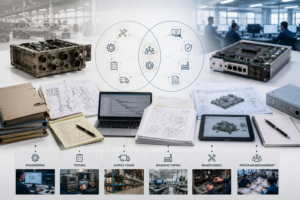
Legacy System Sustainment
New Designs Introduce New Risk
Every redesign introduces uncertainty.
Software integration changes. Qualification timelines expand. Next Higher Assembly compatibility risks emerge. Supply chains must be redeveloped. New components may already be approaching obsolescence before the redesign even enters production.
Programs may spend years and significant resources developing a replacement only to discover that the redesign introduces additional instability, delays readiness recovery, or fails to deliver meaningful operational improvement over the original system.
Providers inherit all the uncertainty of a new program while still carrying the sustainment burden of the old one.
Engineering, manufacturing, supply chain, and program teams are now forced to stabilize the future system while simultaneously preventing the current one from failing operationally.
What initially appeared to reduce risk can ultimately multiply it.
Even after the redesign is complete, legacy configurations and transitional baselines often remain in the field for years—extending lifecycle, logistics, and obsolescence-management burdens across both environments simultaneously.
Legacy System Sustainment Is a Strategic Alternative
The issue is not that redesign is always wrong.
The issue is assuming redesign is automatically required.
In many long-lifecycle environments, the more effective strategy is preserving proven capability without forcing unnecessary disruption across the fleet.
That requires a different operational model.
Legacy System Sustainment
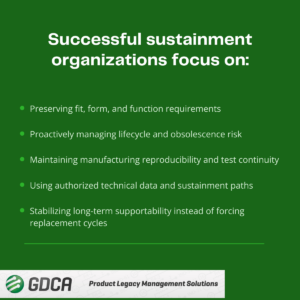
Successful sustainment organizations focus on:
- Preserving fit, form, and function requirements
- Proactively managing lifecycle and obsolescence risk
- Maintaining manufacturing reproducibility and test continuity
- Using authorized technical data and sustainment paths
- Stabilizing long-term supportability instead of forcing replacement cycles
This is not temporary bridge work.
It is a specialized operational discipline focused on sustaining proven capability predictably over time.
Organizations that approach legacy system sustainment strategically can reduce operational disruption, preserve engineering focus, maintain readiness, and extend the operational value of proven systems already deployed in the field.
Final Thought
Do not confuse redesign with progress.
In long-lifecycle systems, the most effective solution is not always replacing capability.
Often, it is preserving operational continuity without forcing unnecessary disruption across the fleet.
Organizations that default immediately to redesign can create years of duplicated operational burden and instability during the transition itself.
Organizations that approach sustainment strategically preserve readiness, maintain engineering focus, and extend the operational value of proven systems already deployed across the fleet.
GDCA helps organizations reduce redesign risk through OEM-authorized New Source of Supply strategies that preserve form, fit, and function continuity, stabilize long-term supportability, and maintain operational readiness across aging fleets and platforms.
_
Thomas Helmonds, GDCA’s Solution Director
