


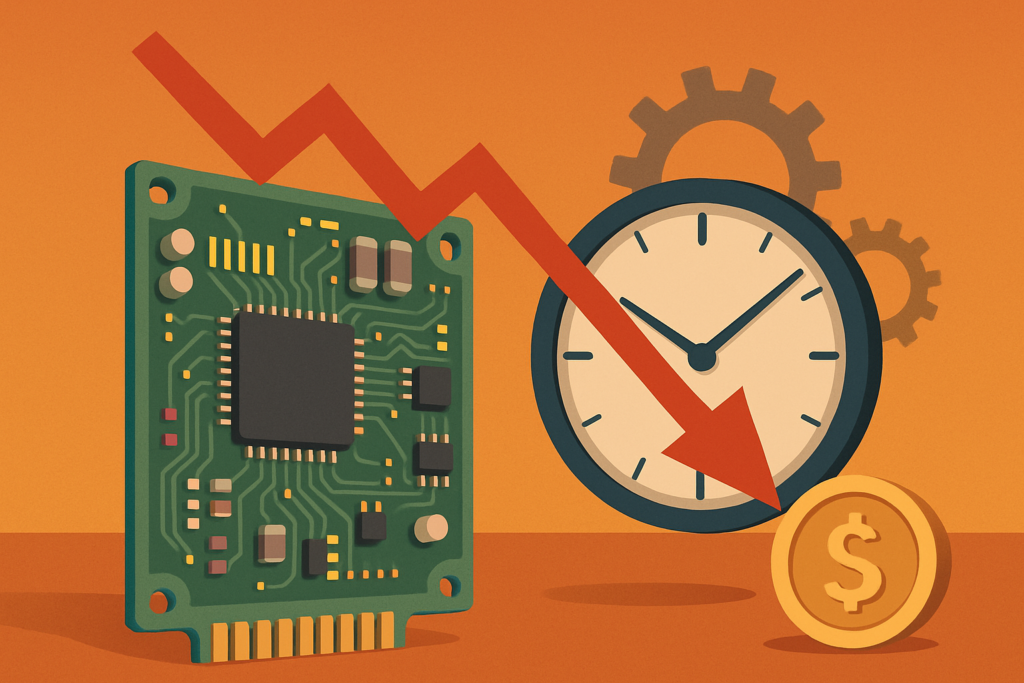
Understanding the True Cost of Tech Obsolescence
Do we, as an industry, truly understand the full impact and cost of tech obsolescence?
Over the past years, the team at GDCA has been doing our best to educate and illuminate the electronics industry on the impact that obsolescence has on every level of our supply chains. Traditionally, product obsolescence was simply managed in-house, or on occasion outsourced to a third party manufacturer. However, traditional obsolescence management–making the necessary parts as needed, trying to find old backstock, or finding a way to work around the obsolete part–only addresses the symptoms. It barely scratches the surface of the full impact of product obsolescence in electronics.
The Cost of Electronic Product Obsolescence: A Theoretical Timeline
Let’s take a single CCA. This circuit card is printed to a certain size, with specific components, and assembled together with other parts that are all designed to fit that specific CCA, and connect it to other parts of the system. The wider system is designed to last at least ten years, fulfilling its function.
After three to five years on the market, demand for the components that make up that CCA decreases significantly, and by seven to nine years, so has the demand for the CCA itself. Customers and OEMs alike naturally move on to other products. Plus, the components needed to make the CCA grow more scarce as demand decreases and their OCMs send out end-of-life (EOL) notices. Eventually, the OEM discontinues their CCA altogether. They may offer a last-time-buy or offer orders from unused inventory, and supply of those replacements last maybe a year or two- if they have enough in stock.
That stock will inevitably run out, and any of those last-time-buy products will need a place to stay until it’s time to use them, meaning inventory costs increase as well. Refurbished products and aftermarket parts may work fine in some cases, but in markets like Defense and Aerospace, these sources present too much risk for counterfeit parts and malware. The Defense and Aerospace markets also have ever-increasing anti-counterfeiting and authenticity requirements that address every level of the supply chain for a CCA, including all of the materials that go into making it–an additional level of complexity that has to be addressed.
However, this just addresses the materials. For older products, the manufacturing techniques and technology could even be outdated, with knowledge of them lost along with the original engineers of the product. An OEM might provide the technical documentation and specifications to manufacture the CCA, but the older that data is, the more fragmented it will be.
All of that, just to find a way to make a single circuit card, and it doesn’t begin to scratch the surface of how deep obsolescence goes.
The engineers who originally designed and tested the PCB retire, or take their career to another company, taking their knowledge of the product, the apparatus required to test it, and the little unique traits that never made it into the technical documentation, with them. The technical documentation might provide the specs, but that doesn’t mean it has everything necessary for testing the PCB’s quality and performance to make sure that a newly-manufactured product will actually function as intended and fit into the wider assembly.
All of this, for just one CCA. Most electronic systems today will have a dozen or more CCAs with already discontinued components, and even more parts at risk for becoming obsolete.
GDCA: Taking into account the full cost of tech obsolescence
The goal of GDCA isn’t just to make spare parts for our customers. Our goal is to take into account the full picture of product obsolescence in electronics. We consider everything–how long a customer needs a part, all of the available and unavailable materials needed to make the part, the support that could be offered by the OEM of the part, the quality testing and control methods needed to maintain the part’s functional integrity, and even the knowledge of those original product developers that may not have made it into the documentation. We look ahead to see how many parts each customer will need, including repairs and replacements, and examine what critical components may be at risk of obsolescence, if they aren’t discontinued already.
We take into account the big picture. And our goal is to encourage the entire electronics industry to do the same.