

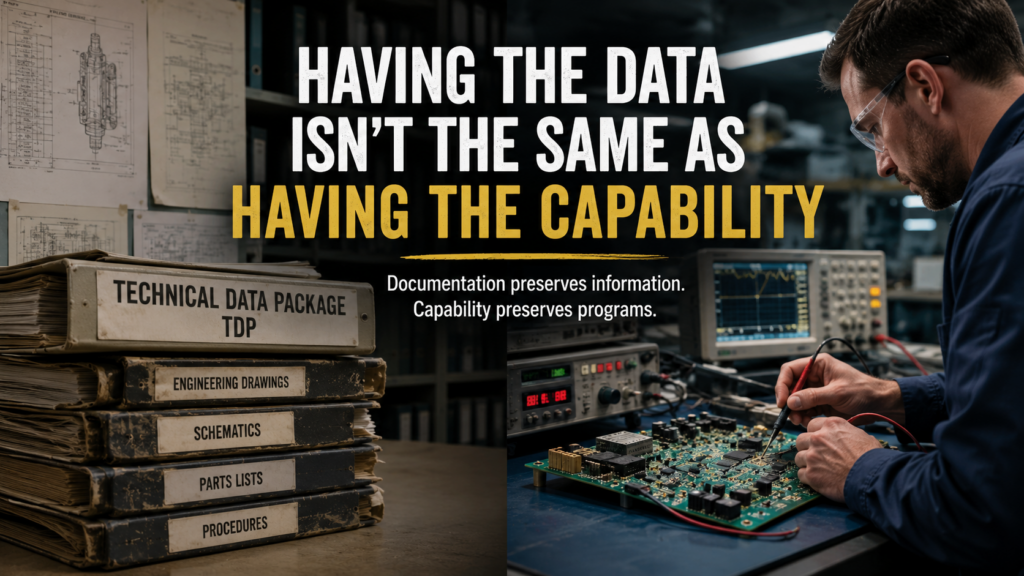
The Sustainment Gap: Why Technical Data Alone Isn’t Enough for Legacy Systems
The Illusion of “Having the Data”
For many organizations, legacy systems sustainment begins with a simple assumption: acquire the Technical Data Package (TDP), transfer the data internally, and supportability will follow.
On paper, it feels logical.
The design exists. The documentation exists. The product should now be reproducible.
But many organizations discover the same reality too late:
A TDP is a resource.
It is not a sustainment capability.
Because successful legacy support depends on far more than understanding how a product was originally designed. It depends on maintaining the operational capability required to manufacture, test, repair, validate, configure, and sustain that product over decades of change.
And once that capability erodes, programs become increasingly difficult to support—even when the documentation appears complete.
Where Sustainment Capability Breaks Down
Documentation Rarely Captures Manufacturing Reality
Drawings and procedures describe how a product was intended to be built. They never capture the full operational history of how it was actually built and sustained over time.
Substitutions are introduced. Processes are modified. Firmware evolves. Test procedures change. Manufacturing deviations are corrected through tribal knowledge rather than formal revisions.
Over years of production and field support, organizations accumulate thousands of operational decisions that never fully enter the documentation set.
When that experience disappears, reproducibility becomes far more difficult than the TDP alone suggests.
Technical Data Still Has to Be Operationalized
Many organizations assume that possessing the data means they possess the capability.
In reality, legacy technical data often exists in obsolete electronic formats, incomplete archives, scanned paper drawings, unsupported software environments, or fragmented revision histories accumulated over decades.
Possessing the files and operationalizing them within modern manufacturing and test environments are very different challenges.
Technical data frequently requires:
- validation
- translation
- reconstruction
- configuration auditing
- and manufacturing interpretation before it can reliably support production or repair
The capability to sustain a product is often far more fragile than the documentation describing it.
Successfully operationalizing legacy technical data requires sustainment engineers, manufacturing experts, and lifecycle specialists capable of interpreting how the product was actually built, tested, repaired, and supported over time.
Test Capability Erodes Faster Than Expected
In many legacy systems, the test environment itself has become obsolete. Rebuilding and refreshing the ability to validate the hardware is often more difficult than rebuilding the hardware itself.
Fixtures degrade. ATE platforms age out. Software environments become unsupported. Drivers, interfaces, and operating systems disappear from commercial availability.
At the same time, portions of the validation process often remain dependent on institutional knowledge that was never formally documented—how failures were interpreted, how to isolate faults, ECOs that improved designs.
Eventually, organizations may still possess the test procedure while losing confidence in the validity of the test itself.
Supplier and Configuration Drift Compound Over Time
Legacy systems rarely remain static across decades of support.
Components go obsolete. Suppliers exit the market. Alternate sources are introduced. Assemblies evolve through small revisions and undocumented field-driven changes.
Maintaining reproducibility and repairability across aging systems requires active lifecycle and configuration management—not simply possession of the latest data.
Without that control, small deviations compound until manufacturing, repair, and support outcomes become increasingly inconsistent and difficult to predict.
Organizations Underestimate the Operational Burden
The most common realization comes late: sustainment is not primarily a documentation problem. It is an operational capability problem.
Many organizations inherit the design data but not:
- the manufacturing continuity
- the validated test environments
- the supplier relationships and knowledge
- the repair infrastructure
- or the institutional knowledge required to support the system reliably
At that point, engineering teams are forced into reactive sustainment work while programs attempt to rebuild capabilities that had quietly eroded over years.
What initially appeared to be a manageable transfer of data becomes a costly and disruptive operational recovery effort.
“We Have the TDP and Smart Engineers — We’ll Figure It Out”
This is where many organizations encounter the real sustainment challenge.
The TDP is acquired. Manufacturing rights are transferred. The documentation appears complete. Leadership assumes the sustainment problem has largely been solved because the organization now has the data—and capable engineers who can work through the remaining gaps.
At first, the assumption feels reasonable.
Then operational reality begins to surface.
Organizations quickly discover that establishing operational capability takes far longer than anticipated. Manufacturing output becomes inconsistent. Repair output is inconsistent. Test gaps emerge. Delivery commitments become increasingly unpredictable. Engineering teams are repeatedly pulled away from roadmap execution into reactive sustainment work.
What was expected to be a manageable support effort becomes an operational tax across the organization.
The sustainment effort begins consuming the same engineering, manufacturing, and leadership bandwidth originally intended for future programs and strategic execution.
Supply chain teams scramble to recover obsolete components and qualify alternates. Manufacturing struggles to implement an old manufacturing process with many gaps. Program teams attempt to explain shifting schedules and uncertain recovery timelines to customers. Leadership attention shifts from future execution to stabilizing legacy support problems that were assumed already solved.
At the same time, the impact spreads beyond the organization itself. End users experience increasing delays, declining availability, inconsistent repair outcomes, and growing uncertainty around long-term supportability.
The cost and time required to stabilize supportability often become far greater than originally expected because the organization is not simply transferring the product—it is attempting to rebuild sustainment capability while actively supporting the installed base.
At that point, the issue is no longer access to technical data. It is the realization that access to technical data is not the same as possessing sustainment capability.
The organization may possess the documentation and talented engineers, but building and sustaining the operational capability required to support the product predictably over decades is an entirely different challenge—one that consumes far more time, cost, organizational bandwidth, and specialized infrastructure than most teams initially expect.
What Mature Sustainment Capability Actually Looks Like
Sustainment capability is not defined by whether documentation exists. It is defined by whether the system can still be supported predictably over time.
That requires:
- technical data auditing and validation
- manufacturing reproducibility
- preserved test continuity
- lifecycle configuration awareness
- supplier recovery and sourcing strategies
- controlled risk management across aging systems
Most importantly, it requires treating sustainment as its own operational discipline—not as a static archive of engineering data.
Organizations that sustain legacy systems successfully maintain the infrastructure, processes, and organizational focus required to keep support capability alive long after the original capability has faded.
Sustainment Capability Must Be Created and Maintained — Not Just Inherited
Technical data can help an organization understand a product.
It does not automatically provide the capability to manufacture, repair, validate, configure, source, and sustain that product over decades of operational change.
That distinction usually becomes visible only after instability appears:
delivery delays,
inconsistent repair results,
test uncertainty,
supply interruptions,
or declining confidence in supportability.
By then, rebuilding sustainment capability is significantly harder—and far more expensive—than maintaining it with a specialized Legacy Equipment Manufacturer.
Final Thought
A Technical Data Package preserves information.
A sustainment capability preserves operational continuity.
The two are related—but they are not the same.
Technical data may preserve the design. Sustainment capability preserves the program.
______
|
|
Thomas Helmonds, Solution Director Email: THelmonds@gdca.com |


GDCA helps organizations preserve and rebuild sustainment capability across aging systems—maintaining manufacturing continuity, test integrity, configuration control, and operational supportability long after original manufacturers have disappeared.
