


Legacy Sustainment In-House: Hidden Risk for Embedded OEMs
What Happens When Embedded OEMs Keep Legacy Sustainment In-House?
A quiet erosion that often ends in a sudden catastrophe.
The risk isn’t always a single, dramatic event; it’s a slow, silent drift. Systems degrade. Critical knowledge walks out the door. Customers grow frustrated. And leadership is often unaware of just how fragile their internal support has become until it’s too late.
Legacy support without a dedicated, structured process creates invisible liabilities that grow over time: compliance vulnerabilities, undocumented fixes, and a slow degradation of product reliability, all of which increase your company’s exposure at the worst possible time.
Can we honestly gauge the true level of risk in your in-house legacy strategy? The process starts with asking a few honest, strategic questions:
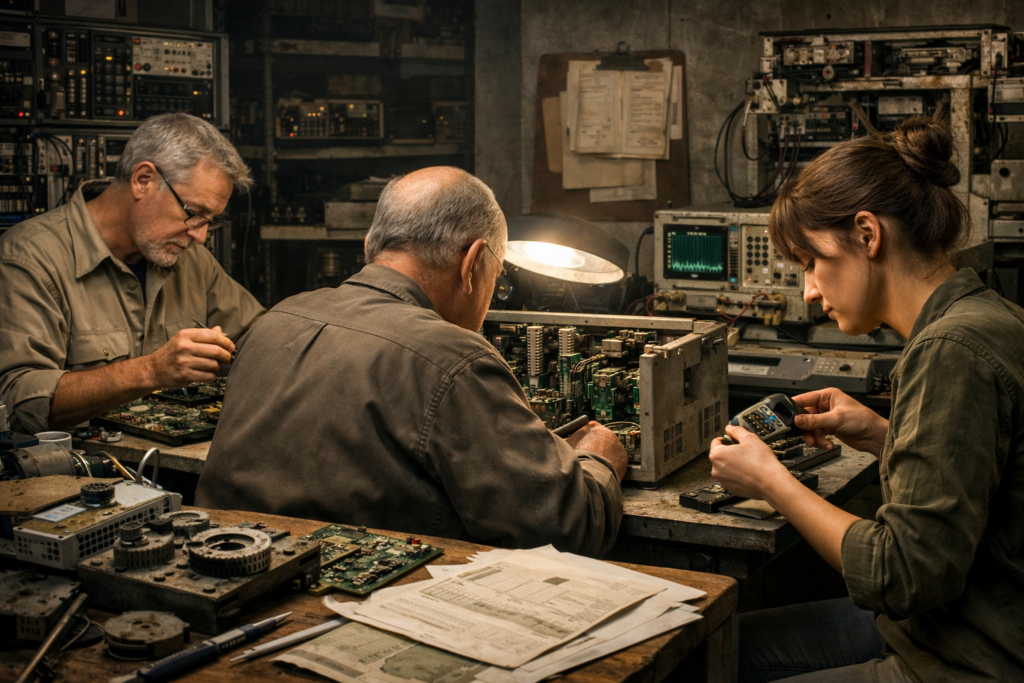
- The “Tribal Knowledge” Question: What would happen if your most senior engineer—the one who knows everything about your legacy products—retires next month? Does the entire support system for a critical product walk out the door with them?
- The “Surprise Audit” Question: How confident are you that your 10-year-old test protocols and informal repair processes would pass a surprise audit from a major defense customer today?
- The “Fire Drill” Question: When a legacy issue finally escalates, how long does it really take for your team to respond, and how much disruption does it cause to your core innovation projects?
These questions aren’t just hypotheticals; they are the cracks in the foundation of a typical internal sustainment model. They are the source of the brand risk that can erase years of goodwill in a single failed support incident.
Strategic Transfer as Risk Mitigation
So, what can a dedicated LEM partner provide?
A partnership with a Legacy Equipment Manufacturer (LEM) turns that unstable internal process into a structured, compliant, and support-ready capability. You retain full control over your IP and your customer relationships while offloading the operational risk.
A dedicated LEM provides:
- Controlled, traceable documentation and formal quality systems.
- Dedicated test infrastructure and standardized repair protocols.
- Institutionalized support workflows that are process-driven, not personality-based.
- A reliable and predictable turnaround for spares and repairs.
This isn’t just outsourcing—it’s stabilizing.
Risk isn’t just failure. Risk is fragility.
If your legacy support depends on a few aging spreadsheets and a single engineer, the risk is already active—you just haven’t been hit yet.
Don’t wait for a support incident to trigger a customer escalation. If you suspect that legacy sustainment is exposing your company to avoidable risk, there is a clear path to stability. We specialize in helping Embedded OEMs reduce their internal dependency and deliver consistent, compliant legacy support that protects both your product lines and your customer’s trust.
______
| Tania Scroggie, Dir. of OEM Relations.
Email: TScroggie@gdca.com Phone: 925-456-9900 |
